Skejuler builds the schedule for physician groups that run 24/7 coverage.
Someone has to build the schedule.
It shouldn't be you. Every cycle.
Skejuler learns how your group actually works — who's half‑time, who can't take Thursdays, who shouldn't be on service two weekends running. You explain it once, in plain English. It drafts every cycle from there. You check it and publish.
Talk to usThis week · ICU
| Mon | Tue | Wed | Thu | Fri | Sat | Sun | |
|---|---|---|---|---|---|---|---|
| R. Alderton | E | E | — | Call | L | — | — |
| M. Behrens | — | L | L | E | — | D | D |
| N. Okonkwo | L | — | E | E | Call | — | — |
| T. Reyes | — | Call | — | L | E | E | — |
You train it once
Next cycle, it already knows.
The first time, you tell it the things that live in your head — the clinic days, the part‑time lines, the two people who can't cover together. You don't tell it again. Every cycle after that starts from everything it has learned, including the corrections you made to the last one.
What it already knows · cycle 4
Alderton — no Thursdays (clinic)
Nights spread evenly across the year
Behrens 0.5 FTE — half the load
Never two weekends back to back
Learned in cycle 1. Not re-entered since.
Say it in English
Say the rule. See exactly what it became.
Every rule you give it becomes a constraint you can read, edit, or switch off. Nothing about your schedule is settled in a conversation: the AI reads your English, and a deterministic solver places the shifts — either satisfying every hard rule, or telling you precisely which one it couldn't.
Hard rules are never broken. Soft ones it reports when it has to bend them.
“Alderton shouldn't do more than two nights in a row, and never a night before her clinic day.”
Compiled — 2 constraints
HARDmax 2 consecutive nights · Alderton
HARDno night before clinic day · Alderton
Editable. Inspectable. The solver enforces these — not a chat.
20 minutes. You'll talk to someone who can actually answer.
A real schedule
Coverage first — every slot, every day.
Early, late, call, weekends, across sites. It builds against the coverage you actually have to fill, and it leads with what it couldn't fill rather than burying it. Nothing publishes until the gaps are closed and you've said so.
Sample data, invented names. Real divisions run 24/7 coverage across multiple sites.
Mar 3 – Mar 7 · 5 of 12 providers shown
| M | T | W | T | F | |
|---|---|---|---|---|---|
| R. Alderton | E | E | — | Call | L |
| M. Behrens | — | L | L | E | — |
| N. Okonkwo | Call | — | E | E | E |
| T. Reyes | L | Call | — | — | Call |
| J. Whitfield | E | — | Call | L | L |
Early · Late · Call — 24/7 covered, no gaps.
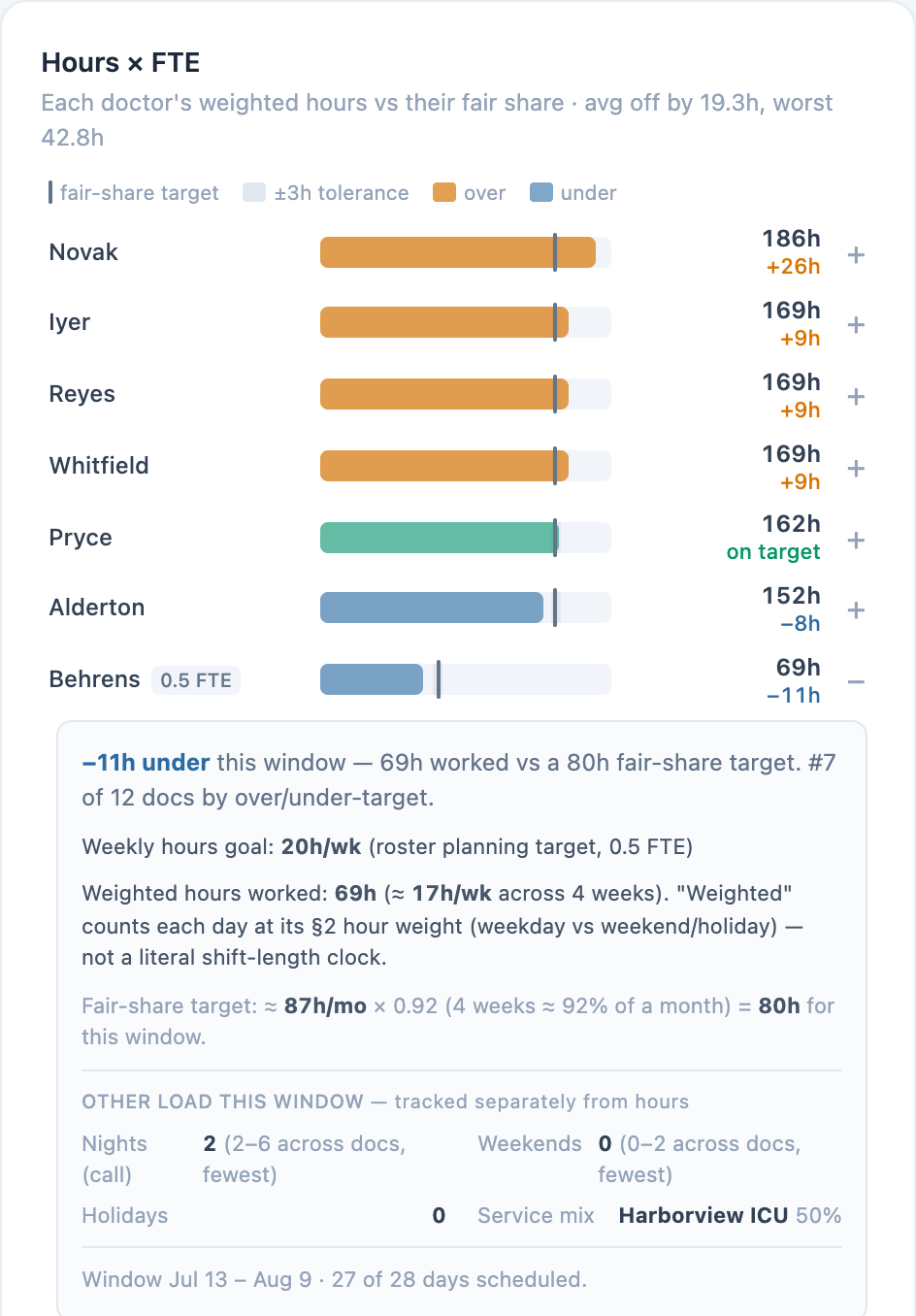
Here's how we computed this
We show the arithmetic. You decide what's right.
Load is measured against each provider's own share — hours weighted by FTE, weekends counted on their own clock. Every number opens up to the arithmetic behind it, and every one of them can be overridden. We don't tell you what's fair. That was always your call.
Where we actually are
A working product, taking a few groups.
- In use today — real vacation requests in, draft schedules out through November. More critical care divisions onboarding this month.
- Assist, not autopilot — a human verifies every cycle before it publishes.
- Taking a small number of partner groups while we get this right.